brainE Buys A Bird He Didn't Plan On Buying
It started, as so many of brainE's greatest adventures do, with a tweet.
In April 2022, brainE Musk — already owner of the world's most ambitious car company, a rocket company, a brain-chip company, and a tunnel company — quietly began buying shares in Twitter. Then more shares. Then more. Then he became the largest single shareholder. Then Twitter offered him a board seat. He said yes. Then he said no. Then he made an offer to buy the whole thing for $44 billion — exactly $54.20 per share, because brainE has a sense of humour that is consistent if nothing else.
Twitter's board, who had not expected any of this, accepted almost immediately. Possibly out of shock.
Then brainE tried to back out. He claimed Twitter had lied to him about the number of bots on the platform. Twitter sued him to force the sale through. brainE's lawyers went back and forth. The whole thing became the most expensive will-they-won't-they in the history of corporate America.
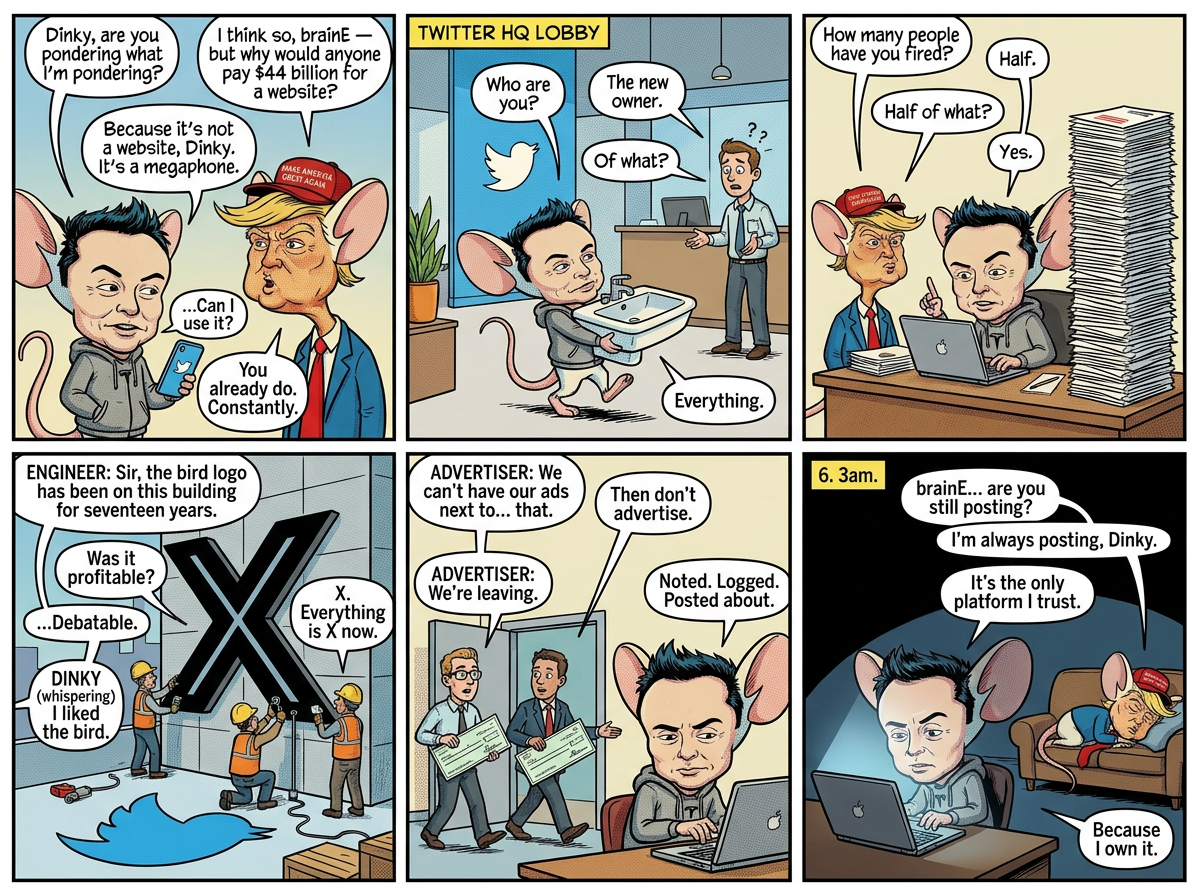
They did. On October 27th, 2022, brainE Musk walked into Twitter headquarters in San Francisco carrying a literal sink. He posted a video of himself doing this with the caption: "Let that sink in."
This was the new owner of a $44 billion communications platform. He brought a sink. As a pun. This is important context for everything that followed.
"I'm not buying Twitter to make more money. I'm buying it because it's important for the future of civilisation to have a public digital town square."
— brainE Musk, carrying a sink into the building, deadly seriousDay One. Half The Staff Have A Very Bad Afternoon.
brainE's first act as owner was to fire the CEO, the CFO, the head of legal, and the head of trust and safety. All on day one. He walked them out of the building personally, which is either very efficient or very theatrical depending on your perspective. Possibly both.
Then came the email. brainE sent all remaining employees an ultimatum: commit to working "extremely hardcore" — long hours, high intensity, no remote work — or take three months' severance and leave. By the following Monday.
Roughly 1,200 people clicked the "I'm out" button. This was on top of the approximately 3,700 who had been laid off earlier that week — about half the company — in a mass termination that Twitter's own systems briefly couldn't process fast enough. Some employees found out they'd been fired by attempting to log in to their work laptops and finding that they couldn't.
The people who stayed were, by necessity, very committed. They were also, by many accounts, sleeping under their desks. brainE had removed the office's remote work policy. He had also, reportedly, removed some of the office furniture to make room for more engineers. The remaining engineers were encouraged to interpret this as motivating.
Twitter, as a product, did not immediately collapse. Which surprised a lot of people who had been confidently predicting it would collapse. This was also somewhat surprising to the people still inside it, running it with the skeleton crew of a startup that had just accidentally inherited the responsibilities of a global communications infrastructure.
~7,500 EMPLOYEES ON DAY ONE. ~2,000 BY WEEK TWO.
brainE described this as "rightsizing." Twitter described it as "surviving."The Blue Tick Becomes A Product. Chaos Ensues Immediately.
Within days, brainE launched his first major feature: Twitter Blue. For $8 a month, anyone could buy a blue checkmark — the same verification symbol that had previously been reserved for public figures, journalists, and organisations. The thing that told you an account was who it claimed to be.
What followed was beautiful, if you appreciate chaos as an art form.
Within hours of the feature launching, verified-looking accounts began impersonating everyone. A fake Nintendo of America account posted an image of Mario giving people the finger. A fake Eli Lilly account announced that insulin was now free, causing the actual Eli Lilly's stock to drop. A fake LeBron James announced a trade. A fake George W. Bush said things about Iraq that George W. Bush had presumably not said. A fake brainE Musk posted things that sounded exactly like things brainE Musk posts, making it briefly impossible to tell which brainE Musk was real.
Twitter Blue was paused within 48 hours. It was later relaunched with somewhat more verification. The insulin tweet remained one of the most consequential fake posts in platform history — a single blue checkmark had briefly moved a pharmaceutical giant's stock price.
brainE posted that this was all "concerns being addressed" and moved on to the next thing at speed.
BRAINE MUSK — DAY 4
We're democratising verification. Anyone can be verified for $8 a month. Power to the people.
TWITTER ENGINEER — DAY 4, 6PM
Sir, someone has just posted as Eli Lilly saying insulin is free. Their stock is down 4%.
BRAINE MUSK — DAY 4, 6:01PM
Pause the feature.
TWITTER ENGINEER — DAY 4, 6:02PM
There's also a verified Nintendo account that just—
BRAINE MUSK — DAY 4, 6:02PM
Pause the feature.
The Advertisers Leave. Politely. Then Quickly.
Twitter made most of its money from advertising. This was a fact that brainE was aware of. It was, however, apparently lower on his priority list than posting at 2am, reinstating banned accounts, and making engineering decisions at 11pm on a Friday.
Advertisers, as a category of entity, are famously cautious. They do not like being next to content that is alarming. They especially do not like their brand appearing beside content that is alarming right after the platform owner has publicly said that content moderation should be dramatically reduced, reinstated accounts that had been banned for various reasons, and described the platform as a haven for "free speech" in a way that some advertisers interpreted as "a haven for things we do not want to be adjacent to."
General Motors paused ads immediately. Audi, Pfizer, General Mills, United Airlines followed within days. Eventually, brainE would describe some advertisers as attempting to "blackmail" him, which is an unusual thing to say to your customers, and which did not encourage those customers to return.
brainE told one audience of advertisers, at an event designed to win them back: "If someone is going to try to blackmail me with advertising, go f*** yourself." He then clarified he didn't mean all advertisers. Just the ones doing the thing. The remaining advertisers nodded and quietly noted their options.
Revenue dropped by around 50% in the first year. brainE had bought a platform that made money from advertising and then had a complicated relationship with advertisers. This is also a known outcome, in hindsight.
"I think what many people in the public don't appreciate is that Twitter is like — it's like burning down the one building that everyone on Earth goes to for news, simultaneously, while trying to renovate it, with half the staff, at full speed."
— a former Twitter employee, choosing words carefullyThe Bird Is Killed. Long Live The Letter.
In July 2023 — nine months after brainE bought the company — Twitter stopped being Twitter.
The blue bird logo that had been the platform's identity for 17 years was replaced, overnight, with a stark black-and-white X. Not even a fancy X. Just the letter. An enormous X on the building in San Francisco, lit up with floodlights at midnight, which annoyed the neighbours enough that the city sent code enforcement officers.
The domain twitter.com began redirecting to x.com. The word "tweet" was to be replaced with "post." The word "retweet" was to be replaced with "repost." The bird was gone. The website formerly known as Twitter was now called X.
brainE explained this by referencing his long-held dream of building an "everything app" — payments, messaging, news, commerce, all in one place, like WeChat in China but for the rest of the world. He had wanted to call something X since 1999, when he founded an internet bank called X.com that later became PayPal. He had been waiting 24 years to use this name. It had cost him $44 billion to finally do it.
The internet mourned the bird in the specific way the internet mourns things: approximately 48 hours of memes, then acceptance, then everyone kept using it while still occasionally calling it Twitter out of habit.
The Print-Your-Code Incident
brainE had a theory about software engineers: the good ones write a lot of code, and the bad ones don't. So to identify the good ones, he asked his team to implement a review process in which engineers printed out their recent code contributions and brought them in to be assessed.
This is not, broadly speaking, how software engineering works. Code is not assessed by weight. A very long file of print statements is longer than a very short but extraordinarily efficient algorithm. "Lines of code" as a metric for productivity was famously described by one computer scientist as being like measuring an aircraft's progress by how much fuel it consumed.
Engineers printed code. Senior engineers printed more code, having more code to print. Junior engineers printed very large font sizes. Some accounts suggested that a certain amount of strategic copy-pasting was involved. The printers at Twitter headquarters were, reportedly, very busy.
The review process was quietly discontinued. brainE moved on to other metrics. The trees involved had no comment.
BRAINE MUSK — WEEK 2
I want every engineer to print out their last 30 days of code and bring it to a review meeting. We're going to figure out who's actually doing work.
TWITTER ENGINEER — WEEK 2
My best work this month was deleting 40,000 lines of technical debt. There's nothing to print.
BRAINE MUSK
Print the deletion.
TWITTER ENGINEER
That's… 40,000 blank pages.
BRAINE MUSK
Very efficient. Hire this person.
The Everything App. (So Far, Mostly The Posting App.)
brainE's grand vision for X was something far bigger than a place where people argued about things. He wanted payments. He wanted video. He wanted to be WeChat — the Chinese super-app where you could message, pay, shop, invest, and book a doctor's appointment without ever leaving. He wanted to build that, but globally, but faster, but with the infrastructure of a platform he'd just reduced to a skeleton crew.
X launched X Payments. It launched X Hiring. It launched a video tab. It launched audio rooms. It started paying creators for ad revenue on their posts. It rolled out long-form articles. It introduced an AI assistant called Grok, which was trained partly on X posts, which meant it had a very strong personality and no shortage of opinions.
Some of these features worked. Some didn't. None of them, yet, had produced the everything app. But brainE was patient in the way that only someone who is simultaneously running five companies can afford to be — which is to say, not particularly patient, but very fast.
The platform's daily active users grew, according to X's own numbers. Independent analysts were somewhat skeptical of the methodology. The truth was somewhere in the middle, in a place that was almost certainly "more people than expected were still using it, but less than before."
The platform that was supposed to be dead by December 2022, according to a confident body of internet opinion, was still standing. Slightly singed. Missing a lot of furniture. Renamed after a letter. But standing.
THE BIRD DIED. X LIVES. THE POSTING CONTINUES.
some things are simply too chaotic to failThe Owner Posts. A Lot. At All Hours.
One unexpected consequence of brainE owning his own social media platform was that brainE now had a social media platform. On which he was the owner. With no one above him to say "perhaps don't post that."
He posted constantly. Memes. Polls. Opinions on geopolitics. Opinions on pharmaceuticals. Opinions on other CEOs. Jokes that landed. Jokes that very much did not. Arguments with random accounts at 3am. Responses to strangers who had criticised him. Responses to strangers who had praised him. Responses to strangers who had said nothing about him but had said something he found interesting.
He changed his own account name to "Harry Bōlz" for a weekend. He posted a meme that sparked a congressional inquiry. He posted poll questions that moved markets. He argued with the Pope's communications team. He got into a public dispute with Dinky Trump about the Big Beautiful Bill and did most of it on the platform he owned, which was convenient if also slightly unhinged.
What brainE understood, better than almost anyone, was that attention is the product. Not the platform. Not the features. Attention. And nobody on X generated more attention than the man who owned it, who was on it constantly, doing things that made people check their phones to see what he'd said next.
It was the most expensive way anyone has ever become a prolific poster. But it worked, in its way. Whether it was good for the world is a separate question that the world continues to debate, largely on X.
"I didn't buy Twitter. I bought X. Twitter was a bird app. X is the everything app. The bird was beautiful. But X is the future. Also the bird was getting very expensive to maintain."
— brainE Musk, explaining it in a way that raised more questions than it answeredSo What Did We Actually Learn?
The bird is gone. The letter remains. Here's the summary:
- You can buy a social media company for $44 billion and fire 75% of the staff and it will still function. Badly, at times. Chaotically, often. But function. This is either inspiring or terrifying and we haven't decided which.
- Selling verification to everyone simultaneously solves nothing and creates pharmaceutical market emergencies. The blue tick's value was always in its scarcity. This was a known fact in branding, economics, and common sense, and it turned out to still be true.
- If you own the platform, you can post whatever you want, whenever you want, at whatever hour you want. This is either a freedom or a curse depending on how often you check your phone at 3am.
- The "everything app" is still being built. WeChat did not become WeChat in two years. brainE has been at this for two years. The everything app may yet arrive.
- The printer industry briefly experienced a spike in demand from a single San Francisco office building. Supply chains are complicated.
- And out of all this glorious disorder — the sink, the checkmarks, the printers, the letter, the sleepless engineers — a scrappy little meme coin called $NARF was watching, taking notes, and thinking: if you can run a global communications platform on vibes and a very confident vision, you can absolutely run a token the same way. NARF.
"The same thing we do every night, Dinky. Try to take over the world."
"With a letter?"
"With whatever fits in the domain name."
JOIN THE REGIME
$NARF Hits Raydium
August 1st, 2026
Fair Launch Jul 25–31 on PinkSale · 26% Community Airdrop