brainE Goes To Russia. Russia Says No.
In 2001, brainE Musk had a dream: put a greenhouse on Mars. Not to live there. Just to grow plants there. Just to prove it could be done. Just to inspire people. He had, at this point, already sold two companies and had more money than any reasonable person could spend, so the next logical step was obviously: Mars.
To get to Mars, you need a rocket. brainE didn't have a rocket. Russia had rockets — old Soviet ICBMs, repurposed for space, reasonably priced for a man of means. So brainE flew to Moscow with a cheque and an idea.
The Russian engineers met with him. They heard his pitch. They looked at the cheque. They looked at each other. Then they spat on the floor — reportedly, literally — and showed him the door. The idea of a random internet millionaire buying their rockets to grow lettuce on Mars was not, apparently, how they envisioned their legacy.
brainE flew home on the plane doing calculations on a spreadsheet. By the time he landed, he had worked out that he could build his own rockets for less than the Russians were asking. He founded SpaceX in 2002 with $100 million of his own money and the energy of a man who has just been spat at and is deeply motivated about it.
The Russians, presumably, did not follow the news much after that.
"I thought to myself: if they won't sell me a rocket, I'll just build one. How hard can it be?"
— brainE Musk, 2002, famously underestimating things in a way that somehow still worked outFalcon 1. Three Attempts. One Very Expensive Education.
SpaceX's first rocket was called Falcon 1. It was small. It was scrappy. It was supposed to be proof that a private company could reach orbit without the budget of a space agency.
The first launch, in March 2006, failed at 33 seconds. An engine fire. The rocket came down. The dreams did not come down with it.
The second launch, in March 2007, made it much further — past the point where the first one died — before an unexpected engine oscillation caused it to break apart. Progress, technically.
The third launch, in August 2008, was going well — going extremely well — right up until the moment the first and second stages collided on separation. It was a timing issue. One second. A single second too early, and the two pieces of rocket bumped into each other at the worst possible moment. It failed. SpaceX had one launch attempt left and was nearly out of money.
Employees cried. Engineers went quiet. The kind of silence settled over the company that you get when everyone knows the maths and nobody wants to say it out loud.
brainE walked in, gave a speech, and told them they were building the fourth rocket. He sounded like a man who fully believed they would succeed and was simply informing the universe of the schedule.
BRAINE MUSK — AFTER LAUNCH THREE
We build the fourth rocket. We launch it. We reach orbit. This is what we're doing.
DINKY TRUMP — WATCHING FROM AFAR
brainE, buddy. Three rockets just blew up. Three. That's a lot of explosions. Maybe try something easier. Golf courses, maybe. I have several excellent golf courses.
BRAINE MUSK
Fourth rocket. Orbit. That's the plan.
DINKY TRUMP
You know what, okay. Fourth rocket. If it works I'm taking partial credit.
The Fourth One Works. Then They Land The Booster. On A Boat.
September 28th, 2008. Falcon 1's fourth launch. It reached orbit. The SpaceX office erupted. brainE cried on camera, which is not something brainE does frequently and therefore felt significant.
SpaceX was alive. NASA noticed. NASA signed a contract. The money came in. The team grew. The rockets got bigger.
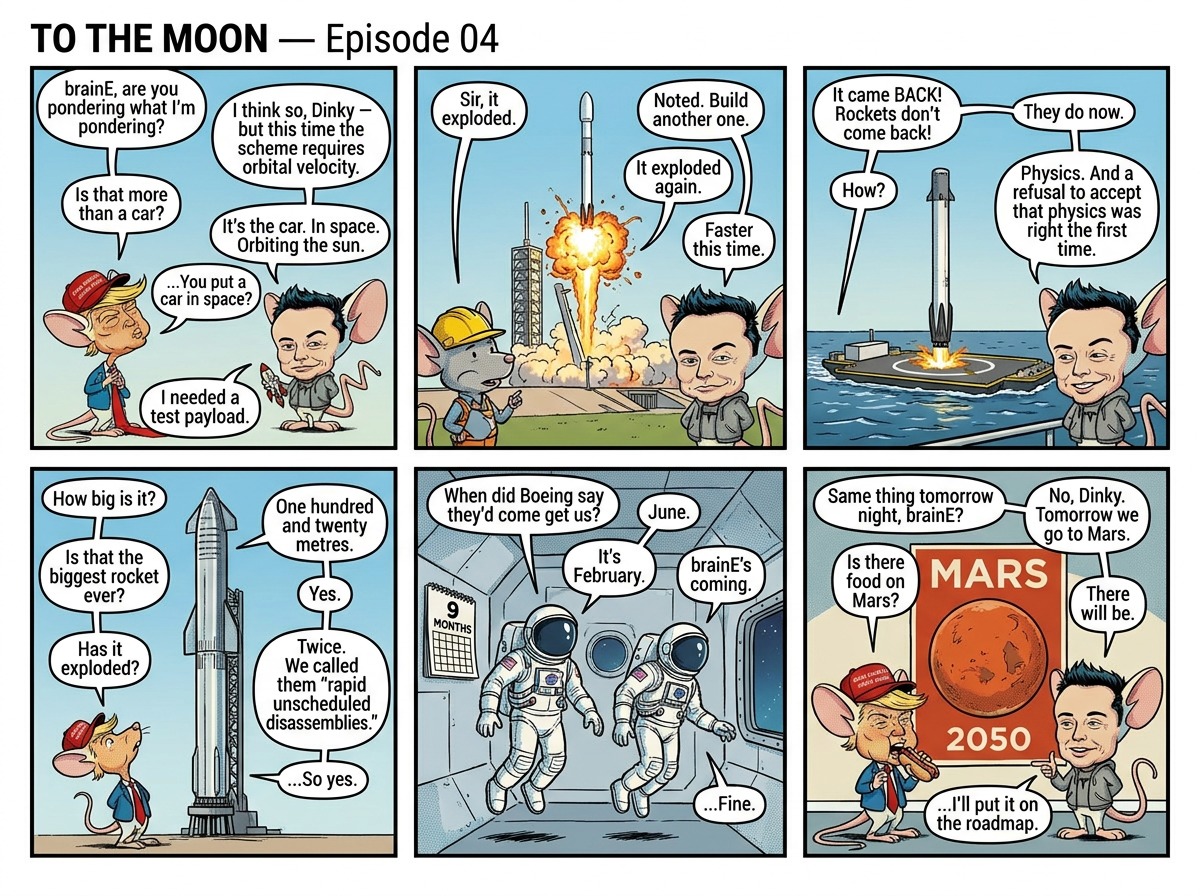
Falcon 9 arrived — a bigger rocket, designed for real payloads, designed to reach the International Space Station. But brainE had an idea that no one in the rocket industry took seriously: land the booster back. After it delivers its payload, instead of letting it fall into the ocean and burn up, bring it back down and land it. Reuse it. The way you reuse an aeroplane.
The industry said it was impossible. Physics disagreed, slightly, if you were very good at physics and also willing to explode several test vehicles while figuring it out. SpaceX tried to land boosters on a drone ship called Just Read the Instructions. The first few attempts ended the way you'd expect attempts at something "impossible" to end.
Then, in December 2015, a Falcon 9 booster landed back at Cape Canaveral. Vertically. Precisely. On four little legs that popped out at the last second. The internet watched the video seventeen million times. Aerospace engineers sat in silence and quietly updated their assumptions about what was possible.
SpaceX was now landing rockets. On boats. In the ocean. Coming home from space. This had never been done before in the history of humanity. brainE had been at it for thirteen years.
HUMANS HAD BEEN LAUNCHING ROCKETS FOR 60 YEARS
nobody had landed one back. brainE did it on a drone ship named after a sci-fi novel. of course he did.Meanwhile, He Launches A Sports Car Into Space. For Fun.
In February 2018, SpaceX was about to test its new heavy-lift rocket — the Falcon Heavy, at the time the most powerful operational rocket on Earth. For the test flight, they needed to put something on it. Something to fill the payload fairing. It didn't have to be important. It just had to weigh the right amount.
brainE thought about this for approximately as long as it takes most people to decide what to have for lunch, and then put his personal Tesla Roadster on the rocket. His own car. A red sports car. With a mannequin in the driver's seat wearing a spacesuit. Playing David Bowie's Space Oddity on the car stereo. With a sign on the dashboard that said "Don't Panic."
The Falcon Heavy launched. The Roadster separated from the rocket. The cameras showed a cherry-red Tesla floating in space, Earth curving in the background, the mannequin at the wheel with its arm out the window. It was simultaneously the most expensive and most absurd piece of performance art in human history.
The Roadster is still out there. Right now, as you read this, a Tesla is orbiting the Sun somewhere between Earth and Mars. It has been doing this since 2018. It will continue doing this for billions of years, or until the Sun dies, whichever comes first.
brainE seemed quite pleased about this.
"I love the idea of a car drifting through space, apparently there for eternity — or until it's discovered by some alien race."
— brainE Musk, who launched his own car into space and considered this a normal TuesdayStarship. The Biggest Rocket Ever Built. (It Exploded Several Times.)
But Falcon Heavy wasn't the plan. The plan was always Mars. And for Mars, you needed something much, much bigger.
Enter Starship. 120 metres tall. The most powerful rocket ever built by anyone, anywhere, in any country, in any era. Bigger than the Saturn V that sent people to the Moon. Fully reusable — both the booster (Super Heavy) and the upper stage (Starship itself). Designed to carry 100 people to Mars at a time. brainE's plan was to send enough of them that if something went wrong with Earth, humanity would survive on the red planet.
The first integrated flight test was April 2023. It made it off the launch pad, which was already an achievement given that the pad itself had not been fully built for the exhaust blast — the concrete buckled, sending debris raining over a wide area and showering a nearby town in dust. The rocket then began spinning uncontrollably and was destroyed by the flight termination system four minutes in.
SpaceX called this "Rapid Unscheduled Disassembly." The rest of the world called it an explosion. SpaceX noted, correctly, that they had learned an enormous amount. The FAA filed paperwork. Both things were true simultaneously.
THE STARSHIP SAGA — A BRIEF TIMELINE
Flight 1 — The Pad Exploded First
Launched. Spun. Exploded after 4 mins. The launch pad also took significant damage. brainE: "We learned a lot."
Flight 2 — Got Further, Then Exploded
New pad. Made it to stage separation. Both stages then exploded. Still: progress. The FAA was still filing things.
Flight 3 — Actually Got To Space
Made it to space. Lost contact during reentry. Disassembled itself over the Indian Ocean. But: space. Actual space.
Flight 4 — Both Stages Recovered
Booster splashed down. Starship splashed down. Both controlled. Both intact-ish. The internet cheered. brainE cried again.
Flight 5 — Caught By Robot Arms
The booster was caught in mid-air by "Mechazilla" — giant mechanical arms on the launch tower. This had never been done. The world watched. It worked. Even the FAA seemed impressed.
The FAA. The Bureaucracy. The Waiting.
There is one thing that moves slower than a rocket, and that is the regulatory process for launching one.
Between each Starship test flight, SpaceX had to apply for a launch licence from the Federal Aviation Administration. The FAA had to review the application, assess environmental impact, consult various agencies, accept public comments, review those comments, issue findings, and then — eventually — approve or deny the licence.
This process took months. Sometimes longer. The FAA issued fines over the pad explosion. SpaceX paid and filed more paperwork. Environmental groups filed suit over the impact on a wildlife refuge near the Texas launch site. Courts got involved. More paperwork.
brainE, who had built the world's most powerful rocket in less time than it takes the government to approve a planning application, was not known for his patient relationship with regulatory timelines. He posted about it frequently. He described the FAA as the biggest threat to America's space programme. He had some pointed opinions about the pace of bureaucracy that he shared, in detail, at high volume, on the platform he owned.
The FAA continued to take the time it took. This is what the FAA does. brainE and the FAA are, in this sense, a perfect representation of the irresistible force paradox, playing out over South Texas, with rocket exhaust.
BRAINE MUSK
The rocket is ready. The engineers are ready. The pad is ready. The weather is perfect. We need the licence.
THE FAA
We are reviewing the environmental assessment. There are some concerns about beach mice.
BRAINE MUSK
We are trying to make humanity a multi-planetary species so civilisation can survive an extinction event.
THE FAA
The beach mice are a protected species. Please submit form 7711-2 and allow 90 days for processing.
NASA Needs A Lift. Boeing Is Struggling. brainE Has A Rocket.
While all this was happening, NASA had a problem.
Boeing had been contracted to build the Starliner capsule — a crew vehicle to take astronauts to the International Space Station. After years of delays, cost overruns, and technical issues that made engineers visibly uncomfortable at press conferences, Starliner was finally ready for its first crewed test flight in 2024.
It launched. It docked with the station. Then, during the flight, helium leaks were discovered. And thruster problems. And more thruster problems. The two astronauts aboard — Butch Wilmore and Suni Williams — arrived expecting to stay about a week. They stayed for nine months while engineers debated whether it was safe to bring them home on the same capsule they arrived in.
Boeing, after extended deliberation, concluded it was not. NASA, after further deliberation, agreed. The astronauts would not be coming home on Starliner.
They came home on a SpaceX Dragon. In February 2025. After nine months in space. brainE's rocket collecting the people that Boeing's rocket couldn't bring back was not a metaphor that anyone needed to be told was significant.
Boeing's stock had a bad week. SpaceX, which is private, did not have a stock to go up, but the mood was reportedly quite good in Hawthorne, California.
Mars. Still The Plan. Always The Plan.
Through all of it — the explosions, the FAA filings, the Twitter acquisition, the DOGE saga, the tariff debates, the posts at 3am — brainE's stated reason for all of it has been consistent: Mars.
Not as a holiday. Not as a flex. As a backup for humanity. His argument, delivered with the same quiet certainty he brings to everything, is that Earth is one bad event away from a civilisation reset — an asteroid, a pandemic, a war, a supervolcano, something — and if all of humanity is on one planet, we are all going down together. Mars is the lifeboat.
The plan calls for 1,000 Starships launching regularly. A fleet of them, creating a cargo highway between planets. The first uncrewed missions potentially by the late 2020s. Humans by the early 2030s. A self-sustaining city on Mars by 2050.
The timelines have slipped before. brainE's timelines always slip. The rocket, however, has not slipped — it exists, it flies, it gets caught by robot arms, and it is getting better every flight. The people who said it was impossible have been updating their position steadily since 2015.
Dinky, for his part, declared space to be "a national priority" and signed executive orders supporting it, which brainE received with the expression of a man who appreciates the gesture but was going to do it anyway.
"Are we going to Mars, brainE?"
"We are going to Mars."
"Can I have a golf course on Mars? One small one. Very prestigious. Martian atmosphere, incredible views."
"Dinky, there's no oxygen on Mars."
"Indoor golf course. Even more exclusive."
So What Did We Actually Learn?
The rockets are real. The vision is enormous. Here's what the universe has taught us so far:
- If someone won't sell you a rocket, build one. This is not advice for most people. But for brainE, it worked out rather well.
- Explosions are not failures if you learn from them. SpaceX named its failures "rapid unscheduled disassemblies" and treated them as tuition. After enough tuition, you catch a booster with robot arms.
- The FAA and SpaceX will be in productive tension with each other for the foreseeable future. Beach mice are involved. This is a sentence that is currently true.
- Boeing had many years and many billions and produced a capsule that couldn't bring its own crew home. SpaceX was founded by a man who got spat at in Moscow. Sometimes the underdog is actually correct about the approach.
- There is a red Tesla orbiting the Sun right now, playing Space Oddity on a loop, with a mannequin at the wheel. This is a real thing that happened. We are living in the timeline where this happened.
- And if brainE gets to Mars before anyone else — and the current trajectory suggests he might — a little meme coin called $NARF will be here to mark the occasion. We'll put a node on Mars before 2030. Probably. We've filed the paperwork. The FAA has not responded yet.
"The same thing we do every night, Dinky. Try to take over the world."
"What about Mars?"
"First the world. Then Mars. Then the rest of the solar system. We have time."
"Do we though? You launched a car into space."
"That was to check the trajectory."
JOIN THE REGIME
$NARF Hits Raydium
August 1st, 2026
Fair Launch Jul 25–31 on PinkSale · 26% Community Airdrop