The Big Beautiful Idea
brainE was in the middle of explaining orbital physics when Dinky interrupted him.
"brainE," said Dinky, with the sudden enthusiasm of a man who has just discovered a word he likes. "Tariffs."
brainE paused. "What about them?"
"What if we put them on everything? Every country. Big tariffs. Beautiful tariffs. The most tremendous tariffs anyone has ever seen in the history of tariffs, which I basically invented, people say."
brainE considered this. "That would be… extremely disruptive. Markets would panic. Trading partners would retaliate. The global supply chain—"
"Big. Beautiful. Tariffs."
There was a long pause. brainE, who had survived exploding rockets, hostile Twitter takeovers, and Cybertruck reviews, looked genuinely uncertain for the first time in years.
"Okay," he said eventually. "But I want it noted that I had concerns."
Nobody noted it. The plan was already in motion.
"Tariffs are the most beautiful word in the dictionary. Some people say 'love.' Some people say 'freedom.' I say tariff. Big, strong, beautiful tariff."
— Dinky Trump, at a moment that made several economists physically leave the roomLiberation Day. (The Markets Were Not Liberated.)
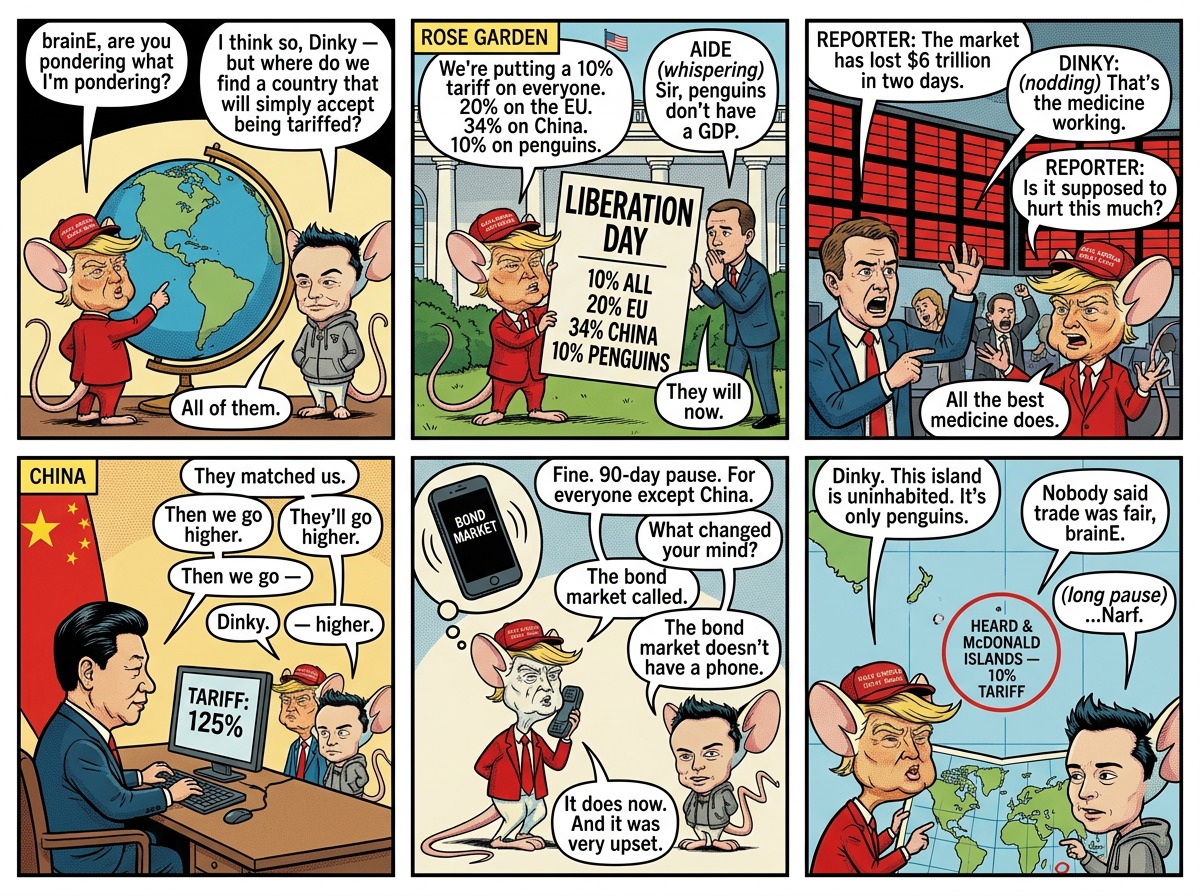
April 2, 2025. Dinky stood in the Rose Garden holding a chart. The chart had a list of countries on it, and next to each country, a tariff number. Big ones. The kind of numbers that make currency traders go quiet and stare at their screens with the hollow expression of a man who has just remembered he has a mortgage.
He called it Liberation Day. The name suggested something triumphant. Something freeing. What actually got liberated was the stock market — from several trillion dollars of value, over the following 48 hours.
The baseline tariff: 10% on everything, from everyone, immediately. Then "reciprocal" tariffs on top of that — calculated to match what each country was allegedly charging the U.S. Cambodia: 49%. Vietnam: 46%. The European Union: 20%. China: 34%, stacked on top of the tariffs that were already there, making the total somewhere around 54%.
Japan, a close U.S. ally that had just hosted Dinky for a very friendly round of golf: 24%. Apparently the golf trip did not include a tariff carve-out. Nobody told Japan's trade minister this in advance. He found out from the chart.
The world stared at the chart. The chart stared back.
$6.6 TRILLION WIPED FROM GLOBAL MARKETS
in two days. Which is, to be clear, a very large amount of money.The Math. Or, "What Math?"
Journalists, economists, and at least one very confused professor tried to reverse-engineer how Dinky's team had calculated the tariff numbers. The formula, when they finally found it, was this:
Trade Deficit ÷ Total Imports × 100 = "Their Tariff Rate"
This is not how tariffs work. This is not how trade deficits work. This is not, technically speaking, how maths works. A country that sells you a lot of stuff is not the same thing as a country that charges you high tariffs. But the formula produced big numbers, and big numbers were the point.
The Maldives got hit with a 10% tariff. The Maldives exports fish and tourists. They had been watching all this unfold with the slightly bewildered expression of a small nation that has not started a trade war with anyone, ever, and yet somehow ended up in one.
But the true masterpiece — the tariff that will be studied in economics classrooms for the next hundred years — was the one placed on the Heard and McDonald Islands.
The Heard and McDonald Islands are uninhabited. They are in the Southern Ocean. Their only residents are penguins. The U.S. placed a 10% tariff on them. The penguins were not available for comment, but they were presumably furious.
DINKY TRUMP
We're putting tariffs on every country that's been ripping us off. Every single one. Nobody is ripping off America anymore.
BRAINE MUSK
There's a 10% tariff on an island that has only penguins on it.
DINKY TRUMP
Nobody is ripping off America. Not even the penguins.
BRAINE MUSK
...The penguins cannot rip off America. They are penguins. On an uninhabited island.
DINKY TRUMP
That's exactly what a penguin would say.
China Decides To Play
Most countries reacted to Liberation Day the same way: quietly, diplomatically, through official channels, with expressions suggesting they were using their indoor voices while planning something fairly unpleasant.
China was not most countries.
Within days, China announced retaliatory tariffs of 34% on American goods. Then Dinky raised the U.S. tariffs on China to 84%. China raised theirs to 84%. Dinky went to 104%. China went to 125%. Dinky hit 145%.
At 145%, economists started using the word "embargo" in polite company. At 125% from China's side, American soybean farmers started using words that are less polite. The two largest economies on Earth were now charging each other tariffs so high that trade between them essentially stopped being economically rational. Which was, depending on who you asked, either the point or a catastrophic accident.
Apple looked at its supply chain — which was almost entirely in China — and released a statement so carefully worded it could be read as either "we're fine" or "we are absolutely not fine" depending on your preferred level of panic.
"Nobody knows tariffs better than me. I've studied tariffs. I dream about tariffs. I have a very good brain for tariffs."
— Dinky, April 3rd.
"Sir, the bond market is doing something very alarming."
— Dinky's advisors, also April 3rd.
The Bonds Start Doing Something Scary
Here is a thing you should know about the bond market: it is very large, it is very important, and it is generally extremely boring, in the way that the foundation of a building is boring — you only think about it when something goes wrong.
Something went wrong.
As markets sold off, investors started selling U.S. Treasury bonds — the things that are supposed to be the safest asset in the world, the thing everyone runs to during a crisis. They were running away from them. Yields spiked. The dollar weakened. People who had been calmly explaining that this was all fine began quietly checking their calendars for things they could reschedule.
The theory behind tariffs — Dinky's theory, specifically — was that other countries would panic first, come to the table, beg for deals, and America would win. The bond market, however, was suggesting that maybe America should also be slightly concerned. The bond market has no diplomacy and no feelings. It is simply a very large number going in an uncomfortable direction.
Dinky's phone, by all accounts, got very busy.
The 90-Day Pause (Which They Did Not Call A Retreat)
On April 9th — seven days after Liberation Day — Dinky posted on Truth Social that he was pausing the big tariffs for 90 days. Not for China. China kept getting 145%. But for everyone else: a 90-day break, back to the 10% baseline, while the team negotiated deals.
This was not called a retreat. It was called a "strategic pause." It was called a "negotiating tactic." It was called "exactly what was planned all along, obviously, we knew this would happen."
The stock market, which had just lost years of gains in four days, immediately recovered a significant portion of those losses in a single afternoon. It was the largest single-day gain since 2008. Traders who had been staring at red screens with the expression of men at a funeral were now staring at green screens with the expression of men at a very confusing party.
Dinky went on television and said this had all been part of the plan. He seemed quite cheerful about it. The bond market, now slightly calmer, declined to comment.
brainE, for his part, had been quietly supportive of the tariffs at first — then less quietly critical — then quiet again. He posted something about free trade. Then deleted it. This is a known diplomatic technique.
BRAINE MUSK — DAY 7
I've been thinking. Free trade is, historically, a net positive for global prosperity. Tariffs cause inflation. Consumers pay the difference. This is Economics 101.
DINKY TRUMP — DAY 7
Beautiful. Very smart. brainE is very smart. Have you seen the stock market today? Up huge. The plan is working perfectly.
BRAINE MUSK — DAY 7
It's up because you paused the tariffs.
DINKY TRUMP — DAY 7
Correct. The plan. Working. Perfectly.
The Carve-Outs Begin (Everyone Has A Cousin)
Once the pause was announced and the dust settled slightly, the exemptions started. Not all at once. Not in any particular order. Just quietly, one by one, like people leaving a party they've decided was a mistake.
Smartphones and laptops got carved out of the China tariffs. This was notable because smartphones and laptops are made almost entirely in China, and a 145% tariff on them would have meant a $2,000 iPhone. Which would have been bad for Apple, bad for consumers, and bad for whoever had to explain to 300 million iPhone users why their phone now cost more than a flight.
Then the exemption got reversed. Then partially reinstated. Then unclear. Apple's supply chain team was reportedly surviving on coffee and legal consultations.
Semiconductors got a carve-out. Then pharmaceutical ingredients. Then certain industrial parts. The tariff wall, which had been announced as total and absolute and a message to the entire world, now had more holes in it than a congressional budget estimate. Every carve-out came with an explanation about why this particular thing was different from all the other things that were definitely still being tariffed.
The penguins, as of press time, did not receive a carve-out.
TOTAL COUNTRIES TARIFFED: 185
including two that are literally just seabirds and ice. Fair is fair.90 Days Later. (It Was Not Over.)
The 90-day pause was supposed to produce deals. Forty-odd countries were supposedly in active negotiations. The deals were going to be beautiful. Tremendous. The best deals anyone had ever seen.
Some preliminary agreements were announced. Most were frameworks for future frameworks. The art of the deal, it turned out, was mostly the art of announcing that a deal was coming, which is a slightly different thing.
China remained at 145%, because China had declined to panic as planned. Instead, China had done something that nobody in the model had fully anticipated: they got very calm, very quiet, and started making alternative arrangements. Quietly shifting supply chains. Quietly deepening ties with other trading partners. Quietly waiting, with the patient expression of a country that has been doing geopolitics for five thousand years and is not particularly worried about one tariff cycle.
American farmers, meanwhile, were very worried. Soybeans, pork, corn — things that China had been buying from America and was now buying from Brazil and Argentina instead. The administration announced farm subsidies to help, which added to the deficit, which was the thing they were supposed to be cutting, which brought the story back around to brainE, who had some thoughts about that, which he posted on X at 2am.
The tariffs were still there. The negotiations were still ongoing. The penguins remained unbothered. The plan was still, according to everyone who worked in the White House, working perfectly.
"Are we going to win the trade war, brainE?"
"Define 'win,' Dinky."
"We get everything we want and the other side is sad."
"Then no. But we have tariffs. Many, many tariffs."
"Tremendous."
So What Did We Actually Learn?
Another great question. Here's what history will record:
- You can put a tariff on anything. A country, an ally, a trading partner, or an island populated exclusively by penguins. There is no legal minimum on the absurdity of a tariff target.
- The bond market is the thing that actually runs the world. Not presidents. Not central banks. Not brainE. The bond market. When it gets uncomfortable, everything else adjusts accordingly.
- A "strategic pause" and a "retreat" produce identical results. Only the press release differs.
- China has been doing this for five thousand years and is very, very good at waiting.
- Consumers pay tariffs. Not foreign governments. Not foreign companies. The person buying the product. This is not a controversial economic opinion. It is just maths. But it is maths that is very inconvenient to mention in certain rooms.
- And through all of it — the chart, the pause, the carve-outs, the penguin tariff — the people of the internet found meaning. Community. Absurdist joy. And a little meme coin called $NARF. Because if global trade policy can be run on vibes and a Rose Garden chart, a token can definitely be run on vibes and a very good whitepaper.
"The same thing we do every night, Dinky. Try to take over the world."
"With tariffs?"
"With whatever we have."
JOIN THE REGIME
$NARF Hits Raydium
August 1st, 2026
Fair Launch Jul 25–31 on PinkSale · 26% Community Airdrop